In this series, we highlight 11 common signs that teams may not be getting the full value from GD&T. Each sign is based on real-world situations we regularly see in engineering, manufacturing, and inspection environments.
For every example, we’ll break down what’s happening, why it matters, and share practical GD&T tips from Tec-Ease to help improve clarity, strengthen communication, and drive better results.
If any of these signs sound familiar, it may be time for a Complete GD&T tune-up — whether that means applying a few targeted tips, utilizing the GD&T Reference Center or investing in more comprehensive training.
You Might Need Complete GD&T Training If...
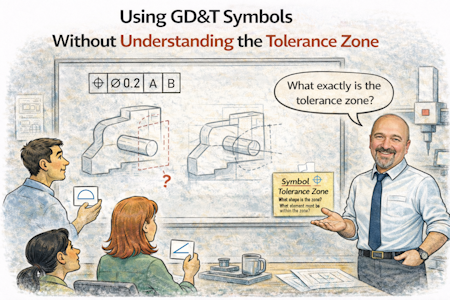
Reason 1: You’re Using GD&T Symbols Without Fully Understanding the Tolerance Zone
If team members can name the symbol but struggle to sketch or explain the tolerance zone, and the feature element that must be within the tolerance zone, that’s a red flag.
Misuse often happens when people memorize symbols without understanding how they work, and what they control.
A Couple of GD&T Tips to Review
Stabilizing the Zone 2009
Projected Tolerance 1994 & 2009
Projected Tolerance 2018
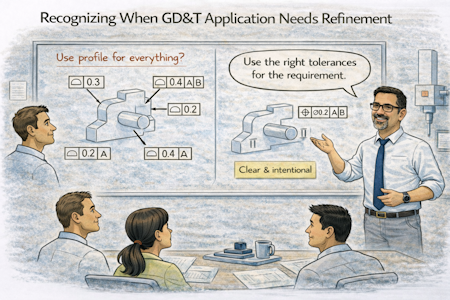
Reason 2: Everything Has a Profile Tolerance
Profile is powerful—but it’s not the answer for every situation.
If profile is being used as a “catch-all” instead of selecting the appropriate geometric tolerance that provides just the control needed for part function, and no more, then the tolerance specifications will not be as simple, intuitive, and readable as they should be.
A Couple of GD&T Tips to Review
Don’t Be Tricky with GD&T 2009
Apply Profile of a Surface to Surface 1994
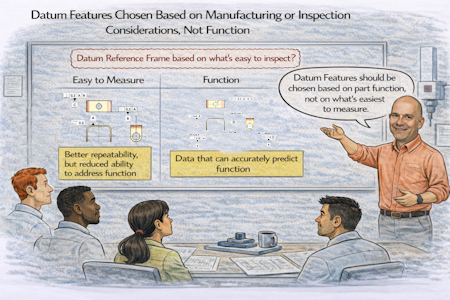
Reason 3: Datum Features Are Most Often Chosen Based on Manufacturing or Inspection Considerations, Not Function
Datum features should reflect how the part functions and assembles—not what’s easiest to measure or fixture and not just based on the features that manufacturing uses in their set-ups.
Datum features selected based on anything other than functional considerations will introduce tolerance stacks, which may lead to a need to specify tolerances that are twice as tight, just to deal with those tolerance stacks. There are times when overall considerations will make manufacturing or inspection-based datum features the best choice, but they will be the exception, rather than the rule.
A Couple of GD&T Tips to Review
Datum Features Based Upon Function 1994
Primary Datum Features Surface Control - 1994, 2009 & 2018
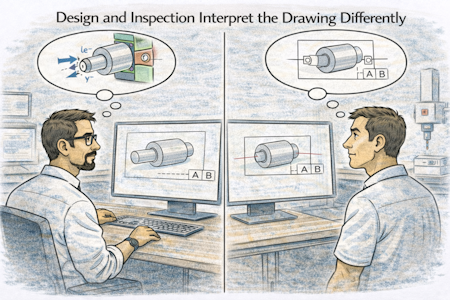
Reason 4: Inspection and Design Interpret the Drawing Differently
If Design and Quality regularly debate what a tolerance “really means,” your GD&T may lack clarity – or there may be an issue with proper understanding within your teams.
A Couple of GD&T Tips to Review
Don’t Be Tricky with GD&T 2009
Don’t Confuse Dimensioning with Tolerancing - 2009
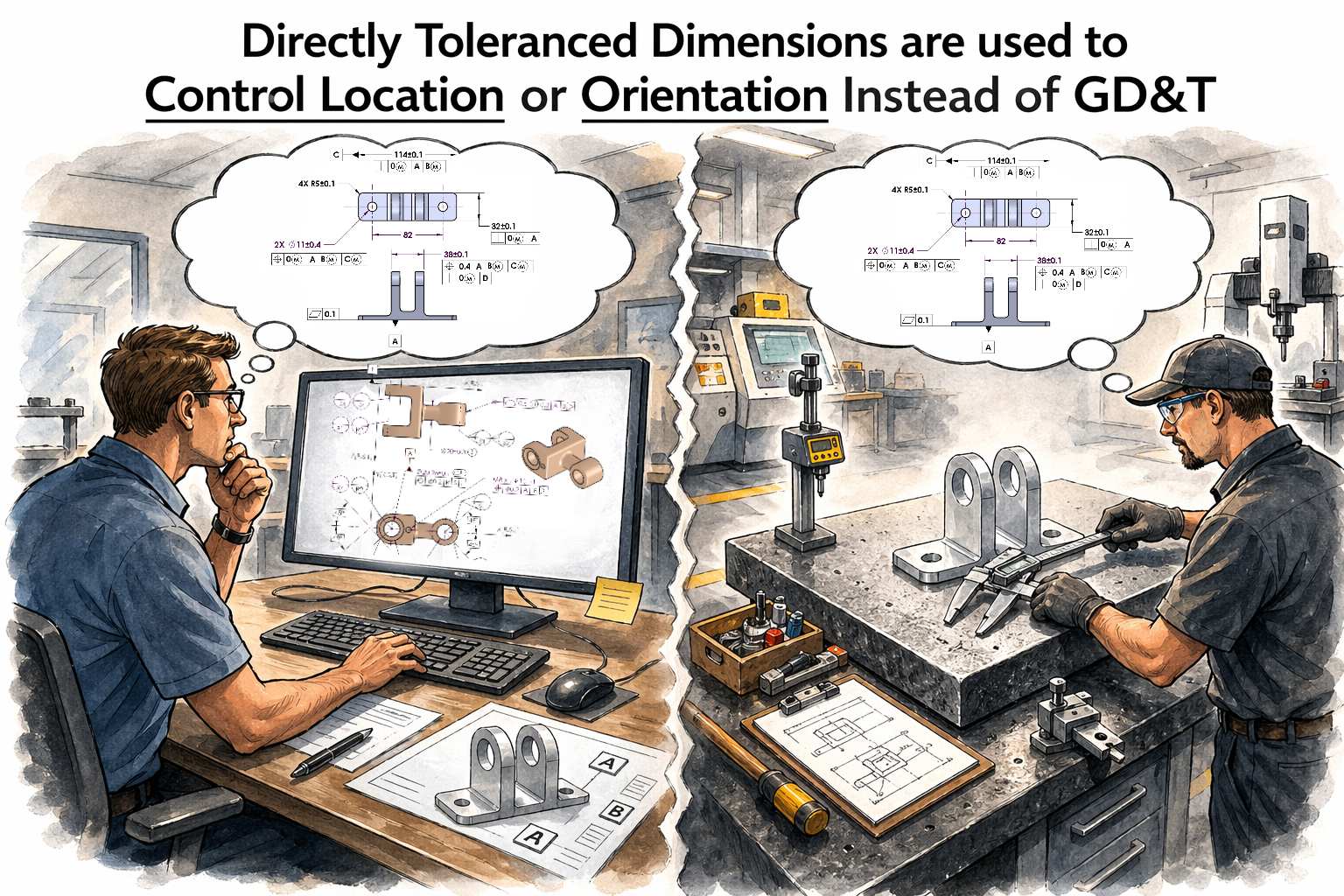
Reason 5: Directly Toleranced Dimensions are used to Control Location or Orientation Instead of GD&T
If location and orientation are controlled with directly toleranced dimensions instead of using geometric tolerances, your team will be creating ambiguous specifications. This means part suppliers will be able to measure the parts in more than one way. The measurement option the supplier will choose for each of these tolerances will be the one that makes the results look good, rather than the one that addresses part function.
A Couple of GD&T Tips to Review
Stop Locating Features with +/- Toleranced Dimensions
If the Drawing Doesn’t Use GD&T--Run
Time to Stop the Nonsense
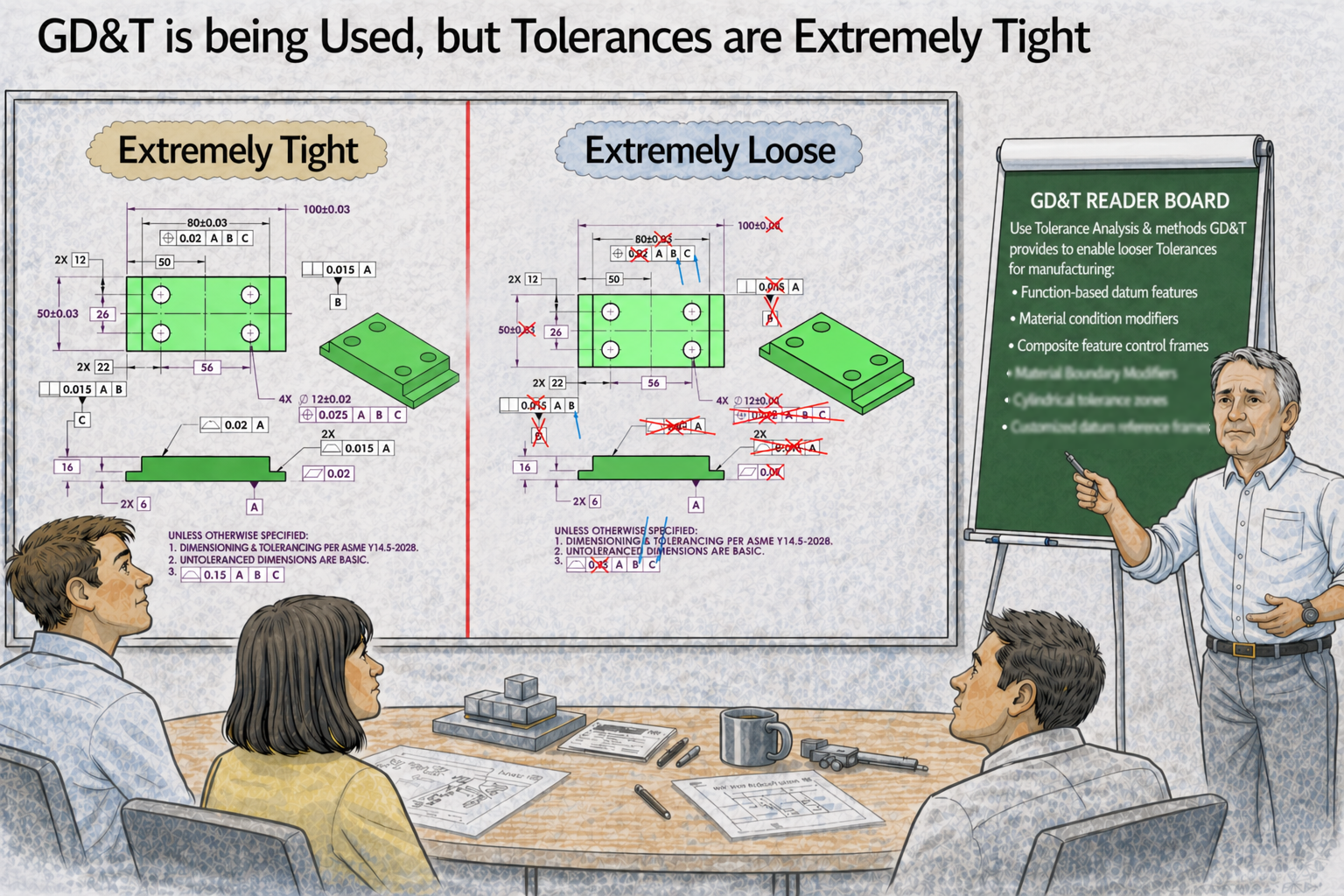
Reason 6: GD&T is being Used, but Tolerances are Extremely Tight
Overly tight tolerances drive up cost. Overly loose tolerances create functional failures.
Both often indicate guesswork rather than functional analysis. A tolerance analysis course for the design group, and GD&T fundamentals courses for all, will provide methods that enable looser tolerances for manufacturing.
A Couple of GD&T Tips to Review
Don’t Be Tricky with GD&T
Don’t Confuse Dimensioning with Tolerancing
Use Profile to Open up Your Tolerances - 1994
Use Profile to Open up Your Tolerances - 2009
Use Profile to Open up Your Tolerances - 2018
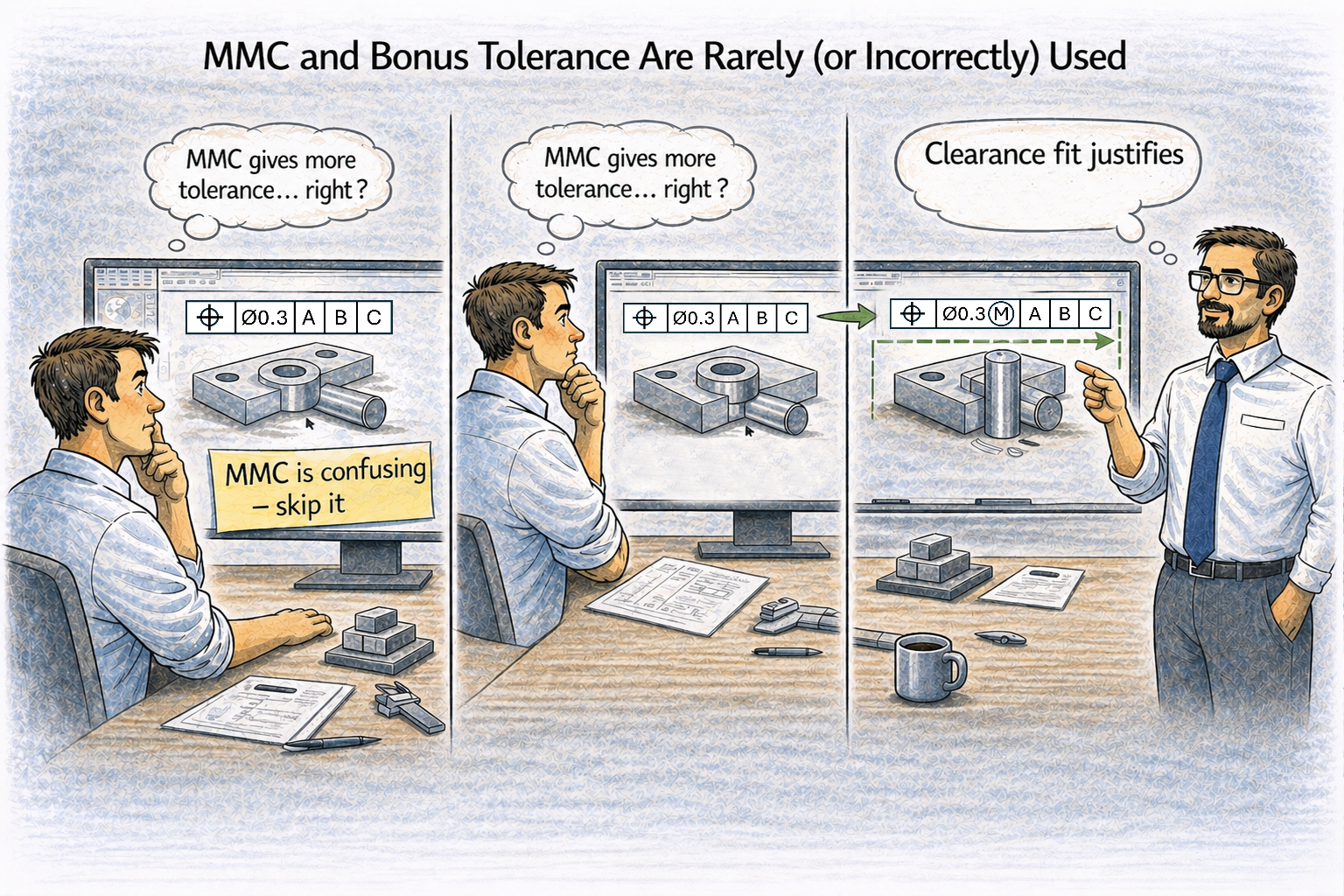
Reason 7: MMC and Bonus Tolerance Are Rarely (or Incorrectly) Used
If MMC is avoided because “it’s confusing,” or used without understanding the functional justifications, there’s likely a knowledge gap. If the functional case is a clearance fit, then all position or orientation tolerances should probably be specified at MMC. If it’s a tight fit, or if the presence of material is important, then the tolerance should not be specified at MMC.
A Couple of GD&T Tips to Review
Calculating Bonus
Think Boundary, not Bonus
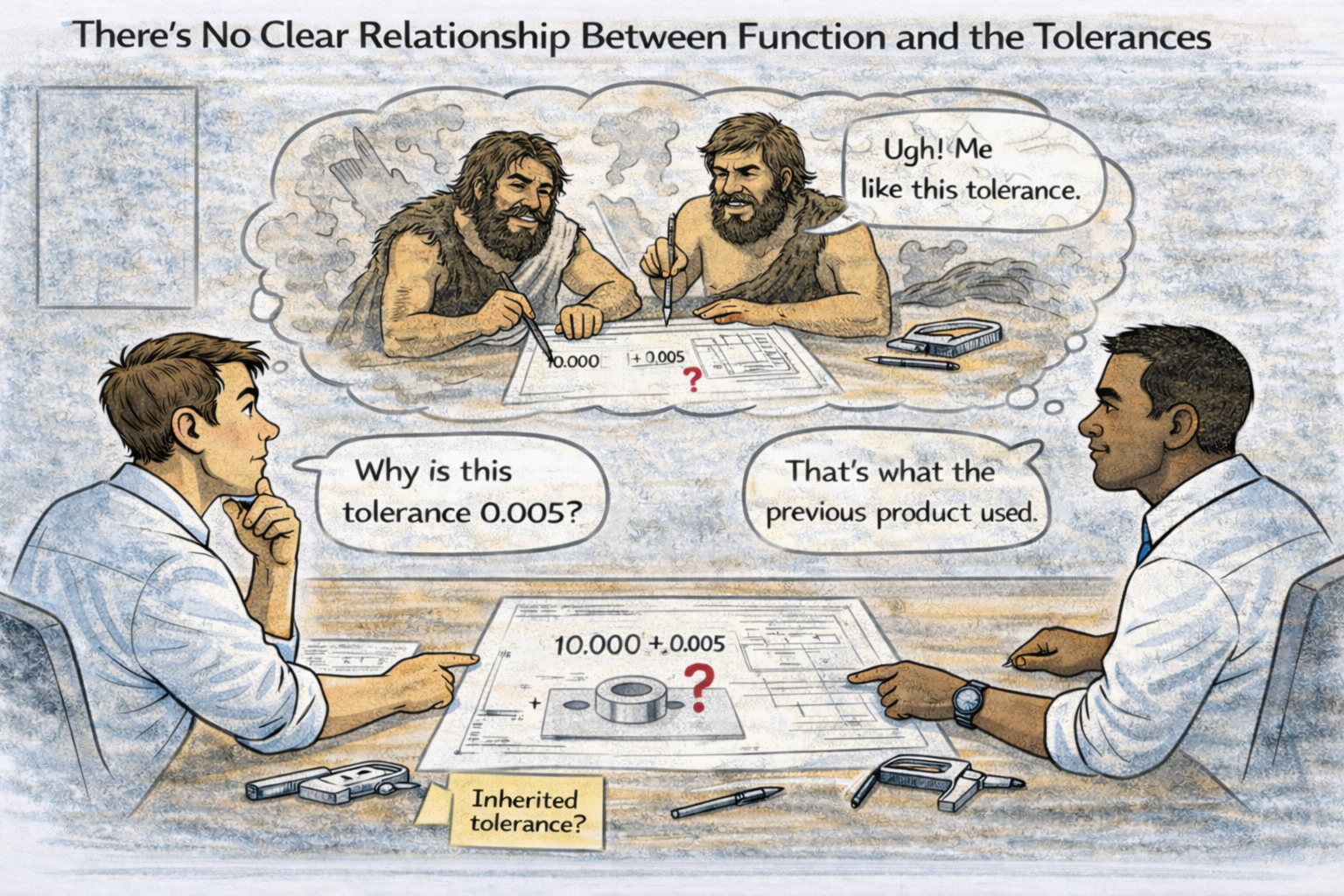
Reason 8: There’s No Clear Relationship Between Function and the Tolerances Specified
If you ask, “Why is this tolerance 0.005?” and the answer is, “That’s what the previous product used,” the team is applying GD&T based on the assumption that the tolerancing was done correctly in the past. The question then is whether the prior team was actually good with their tolerancing approach, or maybe instead they were just made “lucky” by a good manufacturing team that produced nicer than average parts?
A Couple of GD&T Tips to Review
Don’t Get Too Lazy Using Default Tolerances
Datum Features Based Upon Function
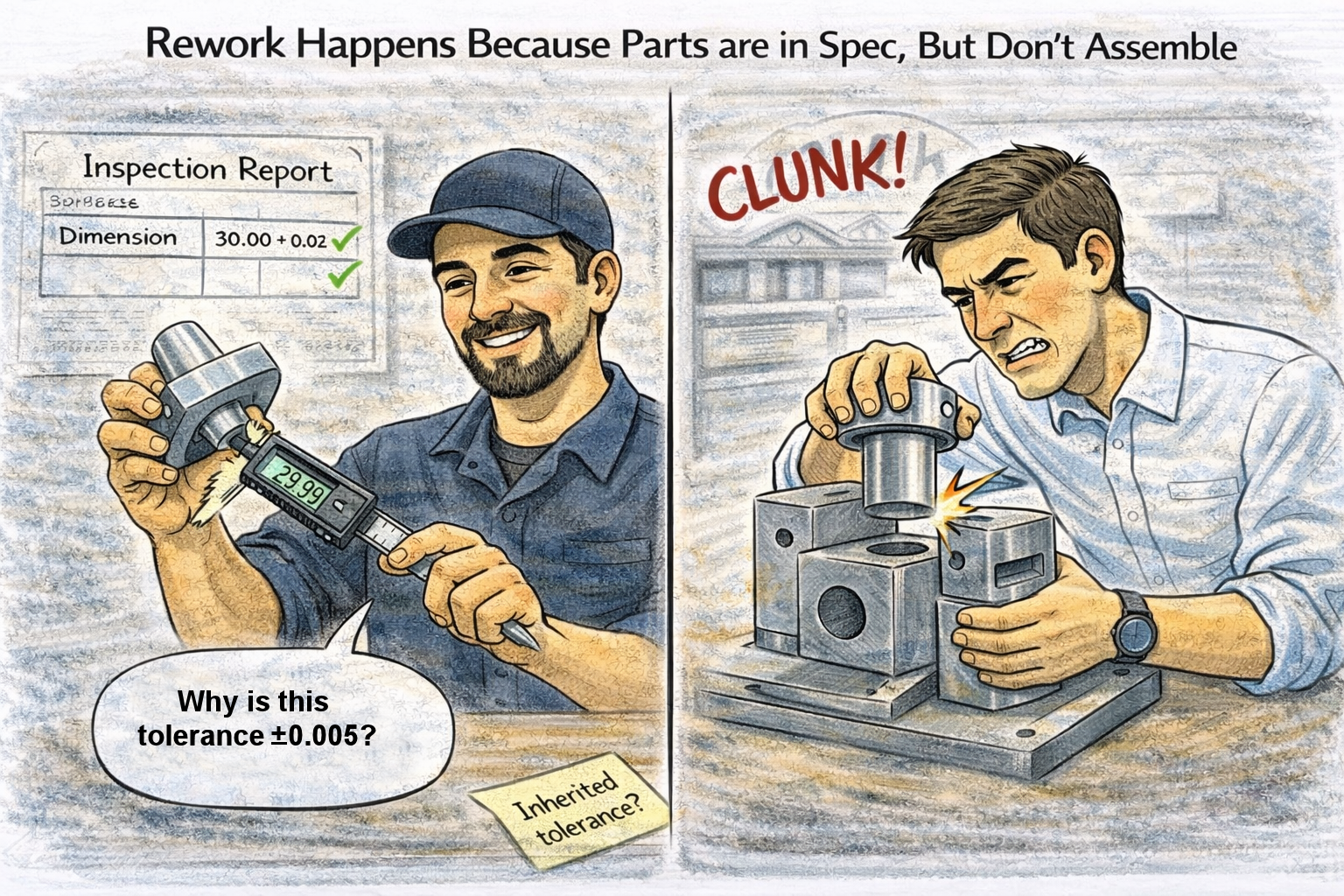
Reason 9: Rework Happens Because Parts are in Spec, But Don’t Assemble
This is one of the biggest warning signs. If parts pass inspection but fail in assembly, the tolerance specifications do not effectively capture the functional requirements.
A Couple of GD&T Tips to Review
Use the Free State Symbol for your Flexible Parts
Projected Tolerance
Don’t Get Too Lazy Using Default Tolerances
When size is really important, throw away your NOGO pin gages
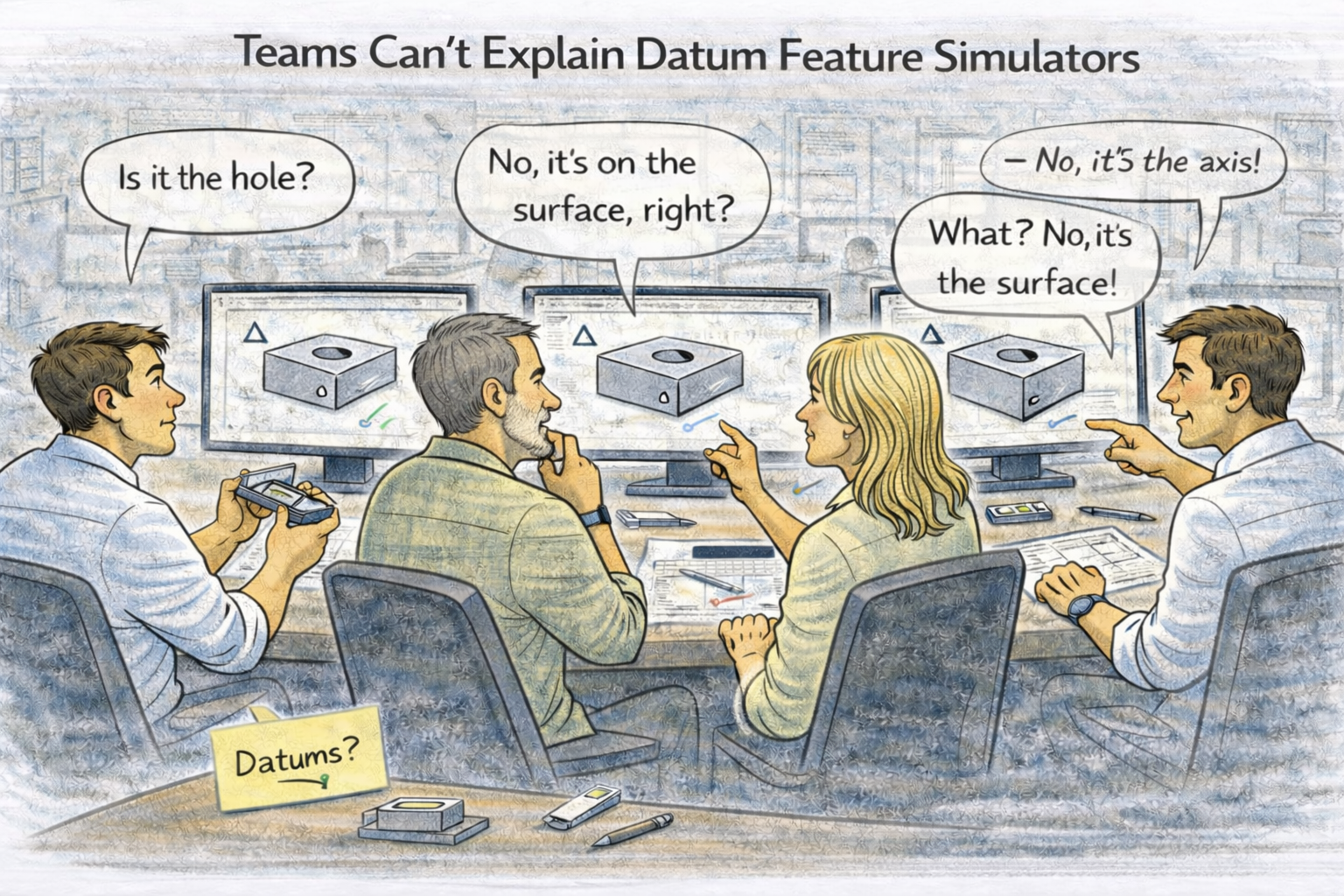
Reason 10: Teams Can’t Explain Datum Feature Simulators or Datum Reference Frames
If there’s confusion between datum features, datum feature simulators, the datums found within them, and how to properly establish a datum reference frame, then fundamental understanding of these very important terms and concepts needs improvement.
A Couple of GD&T Tips to Review
Read the Feature Control Frame to Determine the Origin of Measurement
A Datum Feature Is Not a Datum
It Is Referencing the Datum — Not Itself
Datum features can give you a shift-not a bonus
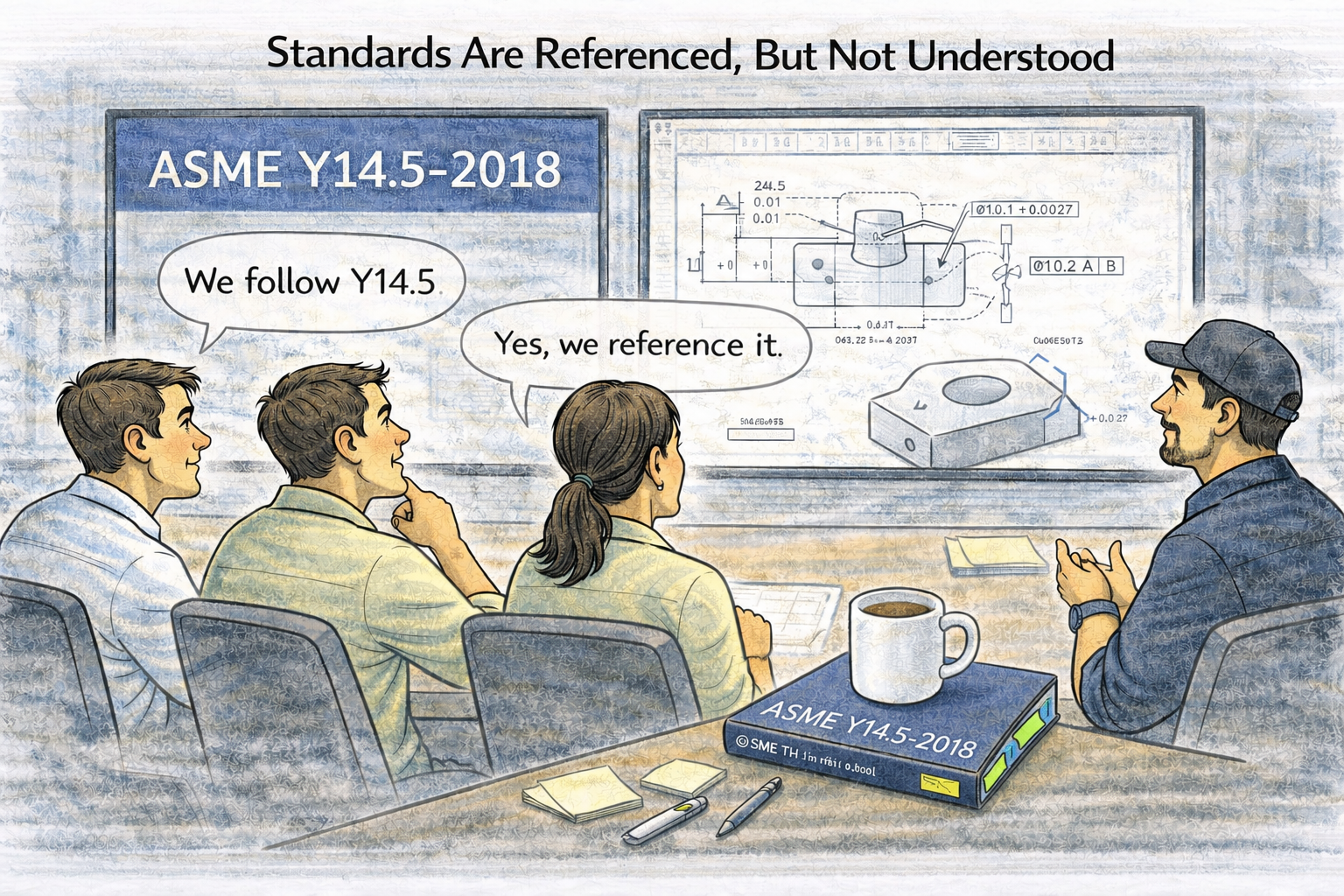
Reason 11: Standards Are Referenced, But Not Understood
If your team references ASME Y14.5 but doesn’t fully understand the proper and effective tolerancing methods that it provides, then there is very little chance the tolerancing applied will enable optimized profit. In fact, it may be worse than just being sub-optimal. Many of the tolerance specifications may be incorrect if the team doesn’t correctly understand the concepts and practices.
A Couple of GD&T Tips to Review
Geometric Control May Be a Matter of Life or Death!
Get Up to Speed with the ASME Y14.5-2018
If You Design Molded, Cast or Forged Parts, You Should Be Using Y14.8
Know which Rules Apply to the Drawing